AR FILTRAZIONI | ENVIRONMENTAL PROBLEM
CO2 emissions in the environment: AR Filtrazioni has always been committed to propose plants which significantly reduce harmful emissions.
The increase of carbon dioxide in the atmosphere, contributes to the greenhouse and the average temperature of the planet, to which ecosystems do not have necessary time to adapt. For this reason, many countries signed the Kyoto Protocol; an agreement whereby nations commit to limiting and reducing carbon dioxide emissions, so that its concentration remains below 450 ppm.
The level of carbon dioxide in the air increases by 2 ppm per year, and is constantly accelerating.
TECHNICAL INSIGHTS
CO2 emissions in the environment and the Theory of Global Warming
If emissions are not reduced according to the agreements of Kyoto Protocol, the threshold level will be exceeded in around 2030. According to the most reliable forecasts, exceeding the threshold would increase the average earth temperature by 2 ° C, raising the sea level at least one meter by 2040. Less likely studies, foresee a temperature increase up to 6 ° C with catastrophic consequences.
The people can notice the increase of extraordinary weather events in recent years.
Italian Legislative Decree 152/2006 indicates the implementation of all the most appropriate measures to reduce polluting emissions into the atmosphere, in order to achieve the objectives deriving from the Kyoto Protocol. CO2 is one of them!
CO2 emissions in the environment
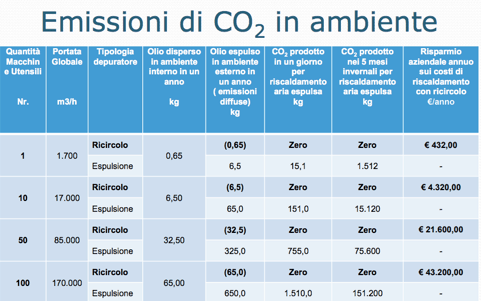
The major pollution problems occur in the winter months and are due to civil and industrial heating, but he production departments of the mechanical industries are increasingly air-conditioned, in the summertime, too. The external expulsion by a centralized filtration system without the possibility of an internal recirculation makes ineffective for environmental protection and extremely expensive. In fact, a filtration system with external expulsion generates a continuous air exchange, with heavily affects on heating/air conditioning costs and contrasts with the intentions proposed by the Kyoto Protocol.
Let’s take the amount of money, considering some dimensional typologies of mechanical companies. We are trying to evaluate the environmental impact of AR Filtrazioni purification systems in every aspect.
THE AIR PURIFIER SENSITIVE TO ENVIRONMENT PROBLEM
AR FILTRAZIONI oil mist collectors, with very high efficiency Hepa filters up to H13 according to the European Norm EN 1822 , have reached highest levels of purification, allowing the re-introduction of purified air inside the workshop. This important goal avoids the creation of fireplaces for external expulsion and guarantees low management costs, flexibility, safety, energy saving and environmental protection.
Some key results:
1 – Safety performances
Residual concentrations of pollutant outgoing from the air cleaner:
➢ Less than 0.05 mg / m3, 100 times lower than the Italian TLV limit and 10 times lower than the more restrictive TLV ACGIH limit (0.5 mg / m3);
Residual concentrations of pollutant in the workshop:
➢ Less than 0.2 mg / m3 (very often around 0.1 mg / m3). Obtained with dozens of working machine tools and in the winter months.
Equal and often improved result if compared with suction systems with external expulsion of the filtered air!
2 – Economic savings:
➢ re-condensation and recovery of the oil directly in the machine tool for reuse (even 6/7 liters per day for an average of € 3 liter).
We have to consider that the oil expelled into the atmosphere settles on the roofs and at the first rain it is washed and transported to the aquifers creating further damage.
➢ with the re-introduction of the purified air inside the work environment without expelling outside, the customer is NOT required to build any chimney and the annual analysis of emissions.
3 – Benefits in terms of savings on heating/air conditioning costs:
➢ Recycling heated air in winter and conditioned in summer is a source of significant energy savings, which translates into an annual Savings of € 415.00 per single air cleaner, with 1700 mc / H air flow rate.
4 – Performance in terms of environmental protection:
➢ Zero exhaust emissions;
➢ The savings on heating/air conditioning allows reduction of:
– 1.96 kg CO2 emissions of CO2 for each cubic meter of methane burned to heat the expelled air;
– 0.53 kg of CO2 for each kWh consumed for the refrigeration, which results in a containment of CO2 emissions of 9,000 kg per year, for each plant installed.
The calculations were carried out considering one shift, for 2 or 3 working shifts the values increase proportionally.
For example: In Italy, each kWh of electricity generates 0.53 kg of CO2 (ENEL sources).
TECHNICAL INSIGHTS
QF Quality Forming Srl – Orzinuovi (BS)
Caso pratico QF Quality Forming Srl – Orzinuovi (BS)
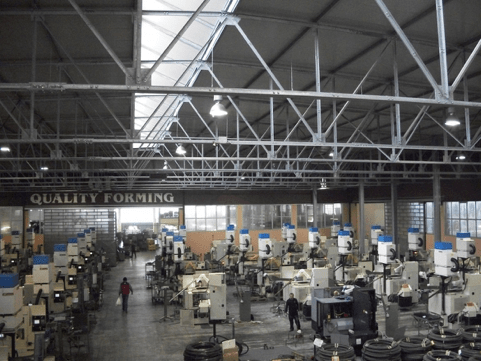
| Type of plant | N. 82 mist collectors (one for each machine tool) by centrifugal abatement and final filtration by HEPA filter EN1822 . Standard air cleaners available on the international market since 2000. |
| Company where the plant is installed | QF Quality Forming Srl – Orzinuovi (BS) |
| Production of the company where the plant is installed | General mechanical metalworking |
| Purified pollutants (type, concentration, mass flow in and out) | Oil mists with metallic particulate and fumes generated by mechanical processing of machine tools; emulsion and oil lubrication cooling. Variable concentrations, maximum 40 mg / m3. |
| Plant description and treatment cycle
| – Nominal flow rate installed 197.900 m3 / h – Estimated effective flow rate 120,000 m3 / h |
| Treated air flow (m3 / h)
| – Removal of wet micro dust by means of a metal prefilter in a calm chamber; – Removal of oil mists and vapors by centrifugation and filtration in accordance with EN779 Norm; – Fume and submicron particles abatement with ABSOLUTE final filtration according to EN 1822 Norm. |
| Actual work activity (h/days and days/year) | 24 h / gg – 360 gg / year |
| Total installed electric power (kW) | 110,25 kW |
Environmental performance
| Chimney emissions (mg / m3 or day/ h) | ZERO emissions of oil mists into the atmosphere |
| Occupational exposure limit detected within the company (mg / m3) | – Oil mists: less than 0.2 mg / m3 – IPA: less than 0.000001 mg / m3 (*) (*) measuring instrument limit)Values detected in the most demanding conditions of use and during the winter months, with doors and windows closed. |
| Installed purification efficiency (E% Integral efficiency for particles of 0.15 microns) | EPA EN1822 E11 – 95<99,5% (for emulsion) HEPA EN 1822 H13 – 99,95<99,995% (for oil) |
| Real purification efficiency (%) | Maximum analysis values at the air cleaner outlet: – Oil mists less than 0.05 mg / m3 |
| Occupational exposure limit according to Italian regulations (mg / m3) | – Oil mists less than 5.0 mg / m3 – IPA lower than 0.2 mg / m3 |
Energy savings compared to the expulsion of filtered air outside
| Heating costs reduction in the 5 winter months (m3 / year x € / m3) | € 137.000 annually Estimated |
| Reduction of CO2 emissions in the 5 winter months (kg / year) | 480.000 kg/year estimated |
Summing up
Learn how to reduce oil consumption, save on conditioning and reduce CO2 emissions.
Fill out the form and our calculation system will immediately quantify the savings you can get and send you the results by email.
Personale serio e qualificato. Leader in questo settore. Mi hanno dato grande assistenza. Consigliato !
 Assicurazioni Lallio10/12/2024
Good products, nice support team.
Henrik Håvardsholm (Merkesystem AS)3/30/2023Good products, nice support team.
Merkesystem AS3/30/2023Good products, nice support team.
Henrik Håvardsholm3/30/2023Good products, nice support team.
Merkesystem3/30/2023supernettes Team, tolle Produkte, sehr gut gemachte Website mit allen notwendigen Informationen.
bewo9/20/2022Mükemmel ürünler, üst düzey uzmanlık! Müşterilerinin ihtiyaçlarını tam olarak analiz edip, gerekli desteği veriyorlar. Daima profesyonel ve dostça bir yaklaşımla, çözüm odaklı iletişim kuruyorlar. Sürekli bilgi ve görüş alışverişimiz var. Kalite, profesyonellik ve deneyim arıyorsanız daha fazla aramanıza gerek yok. Tedarikçileri olmaktan çok çok memnunum.
Gülşah Özünder7/18/20203 Anni con AR Filtrazioni e mai avuto problemi, ottimo servizio e eccellenti prodotti.
Luca Merisio7/18/2020Ditta seria,organizzata, ottima assistenza.. utilizziamo da tre anni i loro prodotti e non cambieremo ! Consigliamo
elena testa6/18/2020Ottimi prodotti di qualità da consigliare ineccepibili
angelo ferrari6/18/2020Professionali e affidabili, da quando li ho incontrati non ho motivo di affidarmi ad altri. Consigliatissimi
riccardo rinaldi6/18/2020Competenti, professionali, puntuali. Consigliati.
Federico Lupini6/18/2020Qualidade ao melhor preço.
Carla Lopes6/18/2020Conoscevo AR Filtrazioni, prima ancora che diventassero miei clienti, come fornitori d'eccellenza. Ottimi prodotti, altissima specializzazione e preparazione, sempre con un occhio attento alle esigenze della clientela, con la quale instaurano un rapporto professionale e amichevole ai massimi livelli. Da fornitore non posso fare altro che confermare tutto quello che già sapevo non solo, abbiamo un costante scambio di informazioni e opinioni. Se cercate qualità, professionalità ed esperienza avete trovato le giuste skills.
Giacomo Barca6/18/2020Spolupráce se společností AR Filtrazioni je velice dobrá.
Libor Hromádka6/18/2020Excellent company, professional approach to customers, price / quality
Anton Zavatski6/18/2020Perfect products, highly evaluated by customers! Very good communication with all from AR Filtrazioni - responsive and willing people! I highly recommend to get in touch with AR Filtrazioni and ask for offer 👍
Jitka Hromádková6/18/2020Good cooperation, good working products, we are very satisfied.
Jaroslav Hospodka6/18/2020Conoscevo AR Filtrazioni, prima ancora che diventassero miei clienti, come fornitori d'eccellenza. Ottimi prodotti, altissima specializzazione e preparazione, sempre con un occhio attento alle esigenze della clientela, con la quale instaurano un rapporto professionale e amichevole ai massimi livelli. Da fornitore non posso fare altro che confermare tutto quello che già sapevo non solo, abbiamo un costante scambio di informazioni e opinioni. Se cercate qualità, professionalità ed esperienza avete trovato le giuste skills.
Giacomo Barca6/15/2020Excellent company, professional approach to customers, price / quality
Anton Zavatski6/12/2020
AR FILTRAZIONI
The company produces filters for oil mist, fumes and dust for the re-condensation and filtration of all types of atmospheric pollutants generated during the machining processes of machine tools, They are mainly used in the mechanical industry.
Company associated with Confindustria and Uniaria


ISO 9001